Random Ramblings from a Republican
"This war is to the end. There will be no interval where we put away our guns, Britain will be out of Ireland and an Irish democracy will be established in the 32 counties with a national government."
- from the PIRA New Year Message 1984
There are many of us still waiting for this dream. It isn't looking like the Provos are helping it much. All they are doing is reinforcing the concept of an illegal border and a military occupation by the "perennial oppressor" mother Britain. Provisional Sinn Fein are betraying the memories of many good men on that Roll of Honour they like to espouse.
The are giving up weapons that are not theirs to relinquish. The arms dumps that they are turning over to the enemy are property of the Irish people; a contingency the Provos no longer represent.
I hope that some day in the future, some of those mesmerised by the power of the Provos will wake up and realise the path of
treachery that the new Fianna Fail has undertaken.
INLA Volunteer Micky Devine
Michael Devine was born May 26th, 1954 on the former American army base, Springfield Camp, outside of Derry City. Unlike his comrades on hungerstrike, Micky did not come from a typically extended family. His father died when he was only 11 years old and his mother when he was a teenager. He grew up fast and fiercely nationalist.
Springfield Camp showed the true side of housing available to poor Catholics in the Derry area. It was meant only for short term living but this soon became extended indefinitely. It was actually into Micky's sixth year that the family finally moved to the newly built Creggan ghetto.
Micky took part in the original Derry riots in 1968 and there he developed his hatred for the RUC. He also participated in the Battle of the Bogside in the summer of '69. Twice in the month in a half, Micky ended up in the hospital after savage beatings from the RUC riot squads.
In 1970, Micky became involved with the civil rights movement as well as the Young Socialists and Labour Party. He became a member of the James Connolly 'Republican Club' and then, shortly after internment, a member of the Derry Brigade of the 'Official IRA'.
1972 was a terrible year for him. Micky was a part of the civil rights march turned bloody on January 30, 1972.
Bloody Sunday was a day that he would remember forever. His mother also died that year from a brain tumor.
Micky became disillusioned with the Sticks in 1973 and their unilateral ceasefire. With the founding of the
IRSP in 1974, Micky had finally the outlet for his socialist convictions. He joined up as one of the Irps and was one of the founding members of the PLA (People's Liberation Army, later to become the
INLA).
Towards the end of 1973, Micky, then age 19, got married. His wife, Margaret, was only seventeen. They lived in Ranmore Drive in Creggan and had two children: Michael, and Louise.
"Red Mick," as he was known both for his ginger hair and his political leanings, was eventually arrested in September of 1976 and charged for his part in an INLA weapon seeking operation. Also a part of this operation was a comrade and friend of Devine's, fellow hungerstriker
Patsy O'Hara. Micky was on remand for nine long months in Crumlin Jail. Eventually he was brought to trial and convicted for the operation. Sentenced to 12 years, Micky immediately joined the blanket protest in the H Blocks.
After four years on the blanket, on the 21st of June, 1981, Micky joined the hungerstrike as the seventh man actively striking (3 having already died,
Sands,
McCreesh and O'Hara).
Micky Devine refused to be labeled a criminal and for this and for Ireland he gave his life. He died on August 20, 1981, after 60 days on hungerstrike. He would be the last of the now revered ten. God rest his soul.
IRA Volunteer Thomas McElwee
Thomas McElwee was born on 30th of November, 1957 in Tamlaghtduff in the
Bellaghy parish of south Derry. Born into a large Catholic family, Tom was the fifth of twelve children. His family lived in a small white-washed house that the father, Jim, built with his own hands.
Thomas and his brother Benedict along with their cousin
Francis Hughes, who lived right down the road, went to school together. They grew up together as friends and developed their ideas of nationalism together as well.
Thomas is remembered by the people of Bellaghy as being sincere and quiet. He liked to help his mother around the house. He also loved the outdoors and he and Benedict would get themselves into many predicaments in the woods and on the country roads.
Thomas also had a very acute sense when it came to engines. He loved working with cars and his interest was even further fueled once he got his driver's license. He enjoyed playing records too, very often of republican ballads, at a time when the 'troubles' had barely begun. Even before 1969, the McElwees, including Thomas, would sometimes go to folk concerts in the village where many of the ballads recalled the tradition of resistance to British injustice.
At fourteen, Tom joined
na Fianna Eireann and began his activism to remove the British presence from Ireland. It was not long before he also joined
Francis Hughes' independent unit of Volunteers operating in the South Derry area. When this entire unit was incorporated into the Provisional IRA, Tom became one of the youngest Volunteers in the area.
He was very active over the next few years; Tom took part in dozens of successful operations with his brother and cousin around the towns of Magherafelt, Bellaghy, Castledawson, and Maghera. These attacks consisted of booby-traps, ambushes, hit-and-run gun fights and landmine attacks. Their unit became one of the most successful and feared of the early 1970's.
Thomas had the reputation of a
principled republican who knew what he was fighting for. He had a great appetite for history, especially local history. He was constantly reading about Republican events and happenings in the Bellaghy area over the last century.
Both because of good luck and his quiet nature, Thomas was never forced to go "
on the run" like his famous cousin Francis. He continued to be harassed though, both by the Brits and the RUC. The McElwee home was raided on a number of occasions and Thomas and Benedict both were arrested.
On the 9th of October 1976, Thomas and Benedict were involved in a pre-mature bomb explosion. Tom
lost an eye while Benedict was comparably lucky, suffering only superficial burns and shock. There were two other Volunteers in the car as well; Colm Scullion, losing several toes and Sean McPeake, losing a leg.
After six weeks in RVH in Belfast, Thomas was transferred to Musgrave military hospital, joining his brother. A week before Christmas, they were both remanded to Crumlin Road jail. After eight months, they were brought to trail. The charged brought against them included: murder and possession of explosives. They were convicted of both charges and sentenced to twenty years.
The charge of murder was
a sham. A girl had been killed in Ballymena the same day the bomb prematurely exploded in the car carrying the IRA Volunteers. Nearly half a dozen other Volunteers arrested in the South Derry area were also charged with this death. Tom and Benedict both appealed the charge and it was later knocked down to manslaughter.
Imprisonment was particularly harsh for the McElwee brothers who were often singled out by prison warders, angry at the brothers' refusal to accept any form of criminal treatment. For a while they were able to keep in touch with each other as they were both in
H6 , but they were eventually split up and had hardly any opportunity to see each other at all for over two years.
After years on the blanket, the brothers joined the thirty strong
hungerstrike in December of 1980 to stand up for the rights of the prisoners. As
Sean McKenna neared death, the strike was called off as an apparent deal was struck with the British. It would not be known until mid January that this deal was a sham and the Brits had
backed out.
Thomas and Benedict put their names in for the 1981 strike but Tom was the one chosen to make the sacrifice. The
determination he showed and his youth together made a statement. He died on
August 8th, 1981 after refusing food for
62 days. He remained
determined and unbroken. His statement had been made. God bless his soul.
McElwee's Farewell, a song
Tribute to Tom McElwee on Ireland's Own
The questionably historical account of Bertie Murphy of Castleisland
Bertie Murphy was seventeen years old when he was shot by the Free State amadans at the beckon of the Crown. During the war against the Black and Tans, Bertie's mother tried like hell to keep him at home and in school but he'd hear nothing of it. He was all for the ideal of the thirty-two county Republic and joined
na Fianna Eireann.
His superior officer in the Fianna, "Hickey," joined the Free Staters "Army" and Bertie took his place as Captain of the Fianna in his area. Eventually, after the outbreak of the Civil War, Hickey came after his former comrade. Using some of the training he received along with his knowledge of the area, Bertie evaded the Free State lackies for nearly six months.
One day in September of 1922, he was walking with his rifle on his shoulder down a bohereen in Dysart by himself when he came upon a patrol of Staters. He was taken prisoner and the bastards threatened to shoot him on his mother's doorstep while she watched.
As they passed by his mothers home, he signaled her to go inside the house to prevent the terror the heartless shites had promised. What she saw as they passed was her son beaten and pale. His face was bruised and his hands were tied behind her back. The Free Staters with Hickey amongst the pack of traitors took him to the local hotel and kept him captive. His mother was allowed to visit him there.
The next morning Bertie's mother heard word that the Free State soldiers had taken her son to Scartaglen to remove a barricade that was feared booby-trapped. In a frenzy, Bertie's mother rushed to the local IRA contingent and pleaded with them to confirm or deny the danger of that specific road block. The officers present promised her that he would be fine if he removed that blockade.
A friend of Berties later saw him walking down a road near Scartaglen with a heavy bag on his back. He was taken from there to the Great Southern Hotel, a recently converted barracks. There were a number of other prisoners in the guard-room with him, a number of whom knew him personally.
traveling with the traitor Hickey and his consort of Irish traitors, Bertie was drug along like a worthless sack of garbage. Eventually, the group encountered an ambush and Hickey took his chance to seek his twisted notion of revenge on Bertie. He grabbed the young man by the throat and threw him down a set of steps. He proceeded to fired numerous rounds into Bertie's body which lay crumpled at the bottom of the flight of steps.
Bertie lived long enough to be given his last rites by the local priest. When the Free State authorities submitted their report of the incident it read: "killed in the ambush in Brennan's Glen." This was just the beginning of a long and terrible history of Free State injustice and brutality amongst Republicans.
*this is a paraphrasing of a piece of Dorothy MacArdle's Tragedies of Kerry of 1923
Fiction and Non-fiction books that are worth a look:
Paddy Clarke Ha Ha by Roddy Doyle
A Star Called Henry by Roddy Doyle
Republican Voices by Kevin Bean and Mark Hayes
The Tain
The Crock of Gold by James Stephens
Opened Ground by Seamus Heaney
Belfast Confetti by Ciaran Carson
Killing Rage by Eamonn Collins
How the Irish Saved Civilisation by Thomas Cahill
Bold Robert Emmet by Seán Ó Brádaigh
IRA Volunteer Kieran Doherty
Kieran was born the 18th of 1955 in the Andersonstown district of West Belfast. He was one of six children to a large working class family. Having a normal childhood, Kieran excelled in sport. He received an Antrim minor metal for
GAA while playing for St. Theresa's GAC.
Kieran and his brothers took up cycling and formed a club within their church. St. Thomas' cycling club would later be ruined by internment. There would be so many of Andytown's boys behind the wire that Brendan Dohery would ask his mother when it would be his "turn to go where the big boys go."
In the summer of 1971, Kieran began an apprenticeship as a heating engineer but never finished because the firm he was working with closed down only months after he had begun. After that, he joined his father as a floor tile worker.
Following the hardest wave of internment, Kieran became disgusted with the treatment of his peers and family members at the hands of the Brits. He had never before been interested in politics, but in 1971 he joined
Na Fianna Eireann, the Republican youth movementt. He soon excelled as a member of that organisation and put him self forth to be recruited by the IRA.
The Provisional IRA members in his area did take notice to Kieran but so did the Brits and soon his family became a constant target for harassment. In October of 1972, he was drug away in the middle of the night by the British who ignored pleas by his parents that he was under 17. They later took a copy of his birth certificate down to the local barracks and forced the Brits to release him.
The Brits were ten days to early; but they were promptly back on the 16th to intern Kieran. He was warned by relativess in the area on his way home from work and hitched a ride to Limerick until the heat came down a bit. He hated being away from Belfast and was back on active duty after Christmas.
Less then a month back, he was arrested and taken to Castlereagh for questioning. After the typical three day questioning period, Kieran was interred in Long Kesh. He would be one of the last internees released in 1975, spending nearly two full years in the cages.
Seething at his imprisonment, he spent his time in lock up fine-tuning his military mind. He took part in the burning of a number of buildings and huts in the concentration camp in October of 1974. Released in November 1975, he immediately reported back to his unit. He joined up with a team of Volunteers from around Rossnareen which gave the Brits in Andytown many sleepless for a full six months until a wave of arrests nearly wiped out the whole unit.
Known by his comrades and friends as "Big Doc," Kieran helped to grind down the Brits in his area. As an active operator, he is remembered as a careful perfectionist who gavehisi comrades a feeling of safety during operations.
Kieran was picked up in August 1976 after an operation against the RUC, completely unarmed. He was alter charged with posession of firearms and explosives and auto theft. The first two charges had no legal merit at all, and the man testifying against Kieran perjured on both counts to see Big Doc convicted in the juryless courts.
Put on remand in Crumlin Road Jail, he met and became friends with
Francis Hughes. Each had great admiration for the other and friends remember the striking similarities in their personalities. They were always defiant and never would give up.
He was sentenced to 18 years for the charges brought against him. Upon entering Long Kesh in January 1978, he immediately joined the blanket and no-wash protests. He spent nearly 3 years on the blanket and only came off when the hungerstrike began. In the H-Blocks he is remembered as being ever defiant to the warders; refusing to acknowledge them as having any authority.
Not surprising to anyone who knew or fought alongside Kieran, he joined the hungerstrike following the deaths of
Patsy O'Hara and
Ray McCreesh on May 22nd. On June 9th, Kieran stood as a candidate for the Cavan/Monaghan constituency and was elected as a TD. On August 2nd, 1981, Kieran Doherty died after 73 days refusing food. He died for his belief in justice for all Irishmen. He died defiant and unbroken by British oppression.
Hungerstrike Commemorative Page
INLA Volunteer Kevin Lynch
Kevein Lynch was born in the village of Park, not far from the town of Dungiven as the youngest of a large Catholic family. Dungiven in 1981 was a small town of a few thousand people but its citizens were predominantly nationalist. Large contingents of both British soldiers and RUC were present in the area.
Kevin had a normal childhood and was very active in GAA. He excelled in both Gaelic football and hurling and played on championships teams in both sports. He also had a short stint as a boxer at St. Canice's and reached the Co. Derry final. He is remembered as a great athelete.
At age fifteen, Kevin left school and began to work with his father as a builder. After a year or so with his father, he joined his brothers to work in Bedford, England in 1973. Shortly after he returned home, he and nine other lads were stopped by a unit of Brits and put against a wall. They were given a bad kicking and two of them were drug away to the barracks.
It was around this time that Kevin joined the INLA, most likely with this event in mind. His brother Michael recalls that "he would never let himself be walked on." He decided to stand up for his rights as an Irishman.
His active service was short, less than six months. He was involved in an ambush in which an RUC man was badly wounded in November of 1976. The RUC decided to make a move against suspected INLA activists in the Dungiven area beginning in December. On the 2nd of that month, the RUC came to drag Kevin from his home. A number of other INLA men were arrested in the local area during that swoop.
After a thre day interrogation period at Castlereagh, a string of charges were brought against Kevin; including conspiracy, taking part in a punishment shooting and taking "legally" held shotguns. After a year on remand in the Crum, Kevin was tried in the Diplock courts and sentenced to ten years on all charges.
He immediately joined the blanket men in H3 on protest and found himself in a cell with his childhood mate Liam McCloskey. They stayed together until the hungerstrike of 1981. Kevin and Liam both took part in the 34 man fast that took place towards the end of the 1980 hungerstrike.
INLA prisoners took a large amount of abuse from the screws and Kevin was no exception to the rule. He was "put on the boards" on a number of occasions. This brutal practice could last up to a fortnight.
He spent four and a half years on the blanket and the day after the deaths of
Ray McCreesh and
Patsy O'Hara, he joined the hungerstrike. He was resolute in his strike and died after 71 days on strike on August 1st, 1981.
Follow up information:
Ireland's Own Hungerstrike Page
Hungerstrike Commemorative
IRSM Fallen Comrade: Kevin Lynch
IRA Volunteer Martin Hurson
Edward Martin Hurson was born 13th September 1956 in Cappagh near Dungannon as the 8th of nine children to a traditional Catholic farming family. Growing up in the predominantly Catholic and nationalist area of Tyrone, Martin experienced the feeling of close-knit communities and of national pride.
He was a fun-loving typical country boy who was very close with his siblings. A devout Catholic and a generally quiet person, everyone remembers Martin as a hard-working and likeable man. He lived a relatively innocent youth; away from the every day British repression. He would not experience the horror of this terrorism until he was nearly 20 years old.
He met the love of his life, Bernadette Donnelly, in the winter of 1975 at her sister's wedding in which Martin was the best man. She would later be a key figure in the hungerstrike campaigns in 1981.
In the spring of 1976, the RUC began to set up what the called "Regional Crime Squads" which were really just crack units of the
sectarian police force. Their primary mission was to ensure that convictions were made for all unsolved republican operations in their respective areas. Their only responsiblity, as then Deputy Chief Constable Ken Newman is quoted as saying, was to
"clear the books" and
"get results."
Martin was arrested in East Tyrone and taken to the Omagh RUC barracks on 11th November 1976. He was
brutally tortured for two days and nights. Beaten beyond any description that could do justice, Martin received repeatedblows to the head and back and was slapped, punched and kicked by multiple RUC officers. Men in adjoining rooms heard his terrible screaming. To avoid anymore of the terrible beatings, he signed documents that admitted his involvement in numerous republican operations in the East Tyrone area.
He was then transferred to Cookstown barracks where he filed a complaint about the treatment he received in Omagh. He was again
beaten and threatened to state that the documents he signed at Omagh were valid. Under great duress, he did so.
Martin was charged along with five other young men for a landmine explosion that occurred at Galbally in November 1975. He was able to beat this charge but the ensuing list of charges were ridiculous. They included: IRA membership, possesion of the landmine that caused the Galbally explosion, conspiracy to murder, and causing an explosion in Cappagh in fall of 1975. The Brits hadn't one shred of physical evidence to support their claims but Judge Rowland said that Martin's statements made at Omagh were enough to satisfy him. He chose to
ignore the reports by prison doctors that documented the extensive beating Martin took at the hands of the "police."
Martin was sentenced to
twenty years for possession of landmines and conspiracy to commit murder. An additional
15 years was added to the IRA membership charge and
five more for an explosion that he had no part in. Martin appealed his conviction which was denied, but a retrial was scheduled.
In this trial, the Omagh statements were ruled inadmissable in the court but the Cookstown statements were accepted. This was a complete contradiction seeing as both sets were signed under heavy pressure. Martin's sentence was not even shortened and he went to Long Kesh and straight onto the blanket. In prison, the British brutality did nto end for Martin. He was beaten on a number of occasions and was one of the POWs singled out for forced bathing during the no-wash protest.
At the end of May 1981, Martin joined the hungerstrike after Brendan McLaughlin suffered a severe stomach ulcer that immediately threatened his life after only 3 weeks on strike. Already weakened from spending the last 5 years in and out of prison, Martin's condition deteriorated rapidly and after only 45 days refusing food, he died on July 13th.
Martin Hurson's death hit the Irish people especially hard coming so shortly after
Joe McDonnell's death and after only
45 days on protest. His body just could not take anymore abuse and he left this world as an
unbroken Irishman. He and his comrades had shown the British policy of criminalisation to be a farce. This was proven by the resolve of the blanket men and the hungerstrikers as well as by the large amount of votes received by prisoners in both Free State and Six County elections.
The British policy of criminalisation was wrong then and will never be right.
Do not let Republican POWs be treated as common criminals.
Martin Hurson bio on Ireland's Own
Irish Political Status Committee
Irish Republican Prisoners Welfare Association
Earlier history of hungerstriking as a tool for bringing about justice
Part 2.
Fianna Fail,
the Republican Party[SIC!!!], in 1939 proscribed the IRA and the jails of the Free State soon swelled with political prisoners. In 1940, prisoners wallowing in the appalling conditions of Mountjoy Gaol began a strike. The strikers included
Tony D'Arcy, Sean McNeela, Thomas Grogan, Jack Plunkett, Tomas MacCutrain and
Michael Traynor. A week into the protest, the prisoners were mercilessly beaten by the Free State screws.
Tony D'Arcy and Sean McNeela paid the ultimate price for their participation in this protest. They died on April 16th and 19th respectively. Shortly after, the hungerstrike was called off when the prisoners were informed that a deal had been struck with the Free State government. This apparent deal was short lived and Free State exploitation of Republicans continued.
The last hungerstriker to perish in a Free State jail was
Sean McCaughey. He was a Belfast native who was O/C of the IRA's northern command in the early 1940's. He was arrested in Dublin for holding an informer (actually the
COS of the IRA!). The charges were common assault and unlawful imprisonment. He was sentenced to
LIFE!
An original blanketman, McCaughey refused to wear the prison clothes of Portlaoise Jail and spent nearly 5 years naked except for a blanket. He commenced his hungerstrike on April 19th, 1946 and after five days began a thirst strike as well. Under these conditions, one cannot live long. Sean died after 17 days on strike. He was rightfully buried in the Republican plot at Milltown in Belfast.
Michael Gaughan was one of the first Provisional IRA members to be imprisoned in England. He was tried and sentenced for his part in a bank raid at Old Bailey in December of 1971.
Frank Stagg was tried and sentenced in November of 1973 in Coventry on an vacuous charge of conspiracy to commit explosions.
Also in November 1973, the
"Belfast Ten" were tried and sentenced to life for bombings that occurred earlier in the year in England. These ten included
Marian and Dolours Price, Gerry Kelly, and Hugh Feeney. These four commenced hungerstrike upon entering prison. They were brutally force-fed for
two hundred and six days.
Gaughan and Stagg joined the strike on March 31st, 1974 primarily to show support for their comrades already on strike and secondly for repatriation. After 23 days refusing food, they were force-fed. This brutal practice involves sticking a thick greased tube down a person's throat and into the stomach. Often the tube enters the windpipe and it was because of this that
Michael Gaughan died. He became ill after the tube punctured his lung, caught pneumonia and died on June 3rd, 1974. This death caused the British establishment much shame and led to the abandonment of force-feeding as a tactic for countering hungerstrikes.
The four strikers of the
"Belfast Ten" ended their strike shortly after and
Stagg's ended on the 7th. Having his demands for repatriation ignored, Stagg began a second strike after being transferred from Parkhurst to Worcestershire. 10th October 1974 was the first day of Stagg's second strike. Thirty one days later he was told that he would be transferred to Long Kesh by March of 1975. He ended his strike in lieu of this deal.
In March of 1975,
Gerry Kelly and
Hugh Feeney were transferred to the cages of Long Kesh and the
Price sisters were repatriated to Armagh Jail. But
Frank Stagg remained in England. Now in Wakefield Prison, Frank commenced a third hungerstrike on the 14th of December 1975. He was to die after 62 days refusing food, February 12, 1976.
Free State officials had Stagg's body diverted from Dublin to Shannon airport to prevent a show of Republican sentiment in the city. The Special Branch thugs then seized his coffin and kept it in the airport for 48 hours before flying it by helicopter under guard to Robeen Church in Co. Mayo. The Special Branch prevented it from being buried in the Republican plot.
Stagg was instead buried 10 metres away and his coffin was covered over top by cement to prevent it from ever being moved. Also, for six months there was a constant Special Branch presence in the cemetery.
This didn't stop the rightful thing from happening. On November 8th, 1976 a group of IRA Volunteers accompanied by a priest tunneled down under the grave and removed the coffin. They buried it in the Republican plot and held a short religious service.
Follow up information:
Overview of the 1981 Hungerstrike
Hungerstrike Commemorative Project
Overview of the 1980 Hungerstriker
Ireland's Own's Hungerstrike Page
Earlier history of hungerstriking as a tool for bringing about justice
The years between 1917 and 1920 involved a number of different hungerstrikes in various prisons both in Britain and in Ireland. It began with the death fast of
Thomas Ashe in September of 1917. Ashe's hungerstrike was completely effective and the prisoners were granted political status. But common to British vindictiveness regarding Republicans, the prisoners' status was revoked and they were all transferred to Dundalk Jail.
Early in 1918, prominent Republican
Austin Stack and a number of other prisoners in Dundalk began a second strike which was soon intensified when the POWs of Cork Jail joined the protest. Their mission was to win back their rightful political status; the reason which Ashe had died in order to bring about.
Terence MacSwiney was a part of this 1918 protest in Cork Jail and was steadfast in his strike. He is quoted as saying, "This may be a fight to the death. And we must stick to it as long as possible." Their protests were successful when prisoners began to fall ill. This shook the British establishment who wanted nothing to do with another fiasco like Ashe's death. The prisoners were all granted one month releases from prison. Their return of course never happened.
Two prisoners fell ill enough that they died soon after being released. Their names were
Seamus Courtney and Aidan Gleeson.
In 1920 the
Black and Tans' scourge of the countryside was raging and Republicans found themselves in prisons in great numbers. Lacking their rightful political status, they decided again to strike for their rights by refusing food.
Sixty POWs took part in this strike and it drew much public attention. After a week of the strike, a general labour strike was called amongst the unions in support of the prisoners demands. This strike had the desired effect. By the 10th day of the hungerstrike the Brits and their lackies gave in and granted the hungerstrikers a
general amnesty!! This date was April 20th, 1920.
Two more men died as a result of the effects of the strike. These men were Patrick Fogarty and Francis Gleeson; both of Dublin.
On August 11th, 1920, a hungerstrike began in Cork Jail which would soon be joined by Cork's Lord Mayor
Terence MacSwiney. After five days in Cork Jail, the O/C of the IRA's Cork No. 1 Brigade was transferred to the British prison, Brixton. He died seventy-five days later on October 25, 1920. His funeral brought the largest crowd in the history of Ireland until
Bobby Sands eclipsed it more than 60 years later.
What is nearly forgotten is that two other men also starved themselves to death for justice on that strike. They were Michael Fitzgerald and Joseph Murphy, striking in Cork Jail for 67 and 76 days respectively.
A very large hungerstrike began in
Mountjoy Jail in October of 1923. It involved an unknown number of Republican prisoners but the number is thought to have been
well over 700 POWs. There were massive protests in support of the strike and support spread to prisons throughout the island. Men and women's prisons alike struck for better conditions and political status.
Two men died on this strike; they were
Dennis Barry and Andrew Sullivan. A number of people also died much later from the long term effects of the hungerstrike, namely Joseph Lacey of Waterford who died only three weeks after ending the strike.
The results of this strike were that all female prisoners were released and a large number of males as well. Conditions were improved to an extent that made them tolerable and livable.
In a separate strike that same year,
John Oliver died in Maidstone Prison in England. He was being imprisoned for his part in the
Connaught Rangers mutiny in India.
(To be continued...)
Republican Voices - Review and Summary
The amount of time editors Kevin Bean and Mark Hayes took to put together
Republican Voices was well spent. This book is a beacon of light at the end of the Provo-ridden literature tunnel. The text is a short compilation of interviews of some of the leading minds of what British lapdogs and Free Staters like the term "dissident" Republicanism.
Those interviewed include Anthony McIntyre, Tommy McKearney, Mickey McMullen, Tommy Gorman, Brendan Hughes and Eamonn McDermott. All of these men were active members of the Provisional IRA and have spent substantial time in British jails for their Republican activities.
Covering subjects of both historical and contemporary topics, the interviewees give a broad-based analysis of the period in which they have lived. The academics give their recollections and opinions of internment, the introduction of the "long war" strategy, the hungerstrikes, the peace process and much more.
Two of the men, Hughes and McKearney, had experience as hungerstrikers during the 1980 protest, both refusing food for fifty-three days. On the 53rd day, with Sean McKenna's health deteriorating, the prisoners agreed to review a shaky deal with the Brits regarding political status. The Brits reneged on their offer and the blanket protest went on.
Their points of view offer valuable insight into the mind of a hungerstriker. They each describe the physical and mental toll the starvation caused them.
All of these men set about in this piece to put into print an alternative view to the current path that the Provisionals are trying to cram down the nationalist population's collective throat. Their reputations within the Republican movement quash any possible type of ulterior motive. They seem to me to be very genuine and many of their thoughts ring true.
The men each give their views on the "transitional" phase Provisional Sinn Fein has been progressing through along with the events and circumstance that helped to bring about the politicisation of the Provisional RM. They incorporate the blanket protests, the hungerstrikes, the TUAS strategy and what they refer to as the "Adams' Plan." They collectively come to the conclusion that the current process is not the way forward. For the most part they agree that PSF's path is one of constitutional nationalism and they are doing nothing but reaffirming the place of the Union and the border.
Asked if their war was worth it, the majority of the activists suggest that while the outcome was not what they fought for, they would do it all over again if need be. Even with their youthful brashness, they believe they were morally justified in fighting the perennial oppressor, Mother Britain. Each one of them expresses great regret for the amount of blood that was shed, but believe that the IRA did what they needed to (speaking in the broad sense of things) out of necessity. They now believe the armed struggle has run its course and that politics are the way forward; just not the politics of PSF. For the most part, these men want to see socialism of some form as the future of Ireland.
Books like this one are key pieces of history. A dissenting view of every major political opinion is needed to genuinely understand the situation. We cannot rely on a solely Provisional perspective of the Troubles and the "peace process" or learning about the true history of the Six Counties will be hopelessly revised.
This is an important piece of literature for anyone looking for another outlook of the issue and future of Republicanism. It is a tangent from the current policies and ideals of Provisional Sinn Fein and should be read by anyone not already under the umbrella of those willing to blindly reinforce the Union with Britain.
Most of these men are still involved with some facet of the Republican movement. Eamonn McDermott now writes for the Derry Journal. Anthony McIntyre is a founding member of the Irish Republican Writers' Group and works with the Ex-Prisoners Assistance Committee. Mickey McMullen is also a member of the IRWG and has written a number of important articles on current Republican strategy. Tommy Gorman works in cross-community initiatives. Tommy McKearney is the editor of the magazine, Fourthwrite and is also a founding member of the IRWG. Brendan Hughes is active in ex-prisoner circles and is currently working on collaborative projects based on the experiences of activists.
The Blanket
Fourthwrite
Irish Republican Writers Group
Purchase Republican Voices on Amazon
Republican Voices on the Blanket
Volunteer Joe McDonnell
Joe McDonnell was born September 14th, 1951 in Lower Falls as one of eight kids to a large Catholic family. Growing up in Lenadoon housing estate, he gained a reputation as a tough but lovable character.
He was interned in 1972 in the prison ship
Maidstone and later in Long Kesh. Upon his release he joined the 1st battalion of the Belfast Bridge. He was active with the A Company which ran most of its operations in the area of Rosnareen in Andersonstown. As a Volunteer, Joe is remembered by his comrades as being cool and collected at all times.
Joe worked as a upholster, making furniture whilst not in prison. He made furniture for all the neighbourhood bars as well as for his family. He loved his work and especially the city of Belfast. He also enjoyed playing with his three children, teaching to swim and playing football with them.
He was arrested after an operation which intended to burn down a high level furniture store as an economic target. A shoot-out with the RUC and British Army ensued in which two soldiers and two republicans were wounded. Among the four he was arrested with was
Bobby Sands. A single revolver was found in the car and all four men were sentenced to 14 years.
He determination is shown by the fact that while he is remembered as a loving father and husband, he did not once don a prison uniform in order to be granted visitation rights. He was on the blanket from the day he entered prison until the day he began hungerstrike.
He was imprisoned in H-5 and acted as the scorcher (shouter of the news) for his wing. He yelled any updates from his block out the window to the adjoining H-block.
A father of two and a veteran of internment from the early 1970's, Joe fittingly volunteered to take his friend Bobby Sands' spot on the hungerstrike when he died. He died 61 days later on July 8, 1981.
He was a genuine person with a great sense of humour who cooly set about completing any mission he had as a Volunteer. He was retracted at times but was no stranger to laughter and friendship. He was sadly missed by his friends and family as well as his comrades and neighbours.
God bless his soul.
Ballad of Joe McDonnell
Hungerstrike Commemorative Project (recently updated)
Hungerstriker: Raymond McCreesh
(Revised)
In 1957, Raymond McCreesh was born in Camlough,
South Armagh as the seventh of eight children to a adamantly nationalist family. He involved himself in the Republican movement in his adolescence, joining
Na Fianna Eireann at 16. Not long after that, he joined the 1st Battalion of the IRA.
McCreesh was employed as a milkman and learned the streets and countryside of his area while performing his routes. This intelligence would greatly aid his comrades activity in that region.
Almost no one save the men he ran operations with knew that Raymond was a Republican. He was always discreet about his involvement. This is amazing when one considers the number of operations Raymond was involved in.
As a part of a four person ASU (active service unit), McCreesh carried out operations against occupying British forces. He was captured after an operation in 1976 and sentenced to 14 years in a star-chamber trial. As many volunteers who were arrested, he refused to accept the validity of the court he appeared in.
In a strange bit of coincidence, the SAS man who first opened fire on McCreesh would later be killed during the wounding and capture of Francis Hughes in South Derry. And also in late 1979, Hughes and McCreesh shared a cell together while on the blanket.
Raymond was not chosen as one of the seven who commenced hungerstrike in 1980, but he was one of the thirty to participate for the last for days of that protest. Hi reputation as a determined Republican soldier put him in the forefront of the Volunteers to be chosen for the 1981 strike. He was the fourth man to join the strike, the same day as his INLA comrade Patsy O'Hara.
He sought strength from his brother, Father Brian McCreesh during his hungerstrike and his brother did not fail him. His brother, to the dismay of the Catholic Church, supported his hungerstrike from day one. In Raymonds final days, Fr. Brian sent an urgent telegram to 10 Downing St. reading:
"My Brother has gone two months without food, and four and a half years without clothes or washing. All he has left now is his pride as a young Irishman, and his loyalty to his fellow prisoners both living and dead" He asked her to respect his dignity and to move to save his life."
Prime Minister Thatcher sent no reply to Brian McCreesh and Raymond died shortly after. After 61 days, Raymond gave his life for his cause; Irish Freedom. He was unbroken and resolute in his strike.
The IRA planted a tribute in Raymond's hometown, Camlough, shortly after his death. This tribute was a 1,000lb bomb that disintegrated a British Army Saracen.
McCreesh fought and died for what he believed was just. This fight is still continuing both in the prison cells and on the streets of the occupied counties. Don't forget about what these men died for, their ideals are not being achieved thru the "mainstream" channels.
INLA Volunteer Patsy O'Hara
Patsy O'Hara was born on July 11, 1957 in Derry city. He was to follow in his brothers' footsteps by joining the Republican movement. His brother, Tony, was also a prisoner in the H-blocks during his Patsy's hungerstrike. Also, the eldest son in the family, Sean Seamus was imprisoned in Long Kesh for a period of four and a half years for Republican activities.
Mrs. O'Hara believes that it was the riots of early 1969 in Derry that first sparked Patsy's fierce nationalism and the
Battle of the Bogside in August of that year helped to firmly seal his feelings. He joined
na Fianna Eireann in 1970.
At the beginning of internment, the eldest O'Hara brother Sean Seamus was arrested. Shortly after this, Patsy was on his way past a barricade when, without warning, the Brit soldiers at the checkpoint opened fire. Hit in the leg, he spent a month and a half in the hospital recovering. These events greatly affected the O'Hara family and helped even more to fuel Patsy's fervor.
January 30, 1972 would be a day that would stew in Patsy's mind until the day he died. His father took him to watch the civil rights march in the city center. They watched the massive march from a distance for a while, as it wound down into the Brandywell portion of Derry. Once it was in the distance, Patsy went back to his house and listened to the hell unfold on the radio broadcast. The horror of the murder of civilians struck him as it did many young men around his age.
His parents knew that date was the culmination of Patsy's bitterness regarding the occupying forces. They knew and supported his obvious decision. Mrs. O'Hara said of her sons: "I thought that that was the right thing to do. I am proud of him, proud of them all."
He became active in the "Republican clubs" in Derry city and was interned in late 1973.
In 1975, at the age of 17, Patsy joined the newly formed
Irish Republican Socialist Party (IRSP) and also the ranks of the INLA. At the young age of 21, he was elected to the ard chomhairle of the IRSP and began to campaign against the star-chamber, juryless courts that Republican prisoners faced.
Patsy was arrested for the fifth and final time in May of 1979 for possession of a grenade. He was tried and sentenced to 8 years by the British judge.
As the leader of the INLA prisoners in the H-blocks, he was the first INLA member to put himself forth for the hungerstrike. He joined his PIRA comrade
Raymond McCreesh on the 22 March 1981. 61 days later, both men succumbed to death by starvation; asking only for five simple things:
1. not to have to wear a prison uniform;
2. not to have to do prison work;
3. to freely associate with other prisoners
4. to organize their own educational and recreational facilities;
5. one visit, one letter and one parcel per week. *
During the Blanket protests Patsy was quoted as saying: "We stand for the freedom of the Irish nation so that future generations will enjoy the prosperity they rightly deserve, free from foreign interference, oppression and exploitation."
May this dream be realised on the ideals of these brave men. In the words of Patsy O'Hara; "Let the fight go on!" Do not let the
Provisional Sinn Fein leadership walk across the graves of some of Ireland's bravest men and straight into
Stormont. This treaty of surrender is not what the Volunteers died for.
IRSCNA Piece on Patsy
IRSM Commemoration Statement 2000
*These demands are still being sought by the Republican POWs. Support them in their struggle.
In light of studying for finals, I will have no creative article for today. I apologise. Here are some interesting articles and pages to read instead:
The GFA and Other Fairystories in the latest edition of
the Blanket
Some Thomas Moore Poems
Works of Liam O Comain
Army by
Ciaran Carson
An Irish Christmas - Then & Now by Bridget Haggerty
Revolutionary Woman: Kathleen Clarke
Kathleen Daly Clarke was born in Co. Limerick in 1878 into a family with strong Republican tradition. Her uncle was John Daly, of Fenian fame and her brother
Edward who was a key player in the
Easter Rising.
She was politically active in republican circles and was soon acquainted with long time Republican
Thomas Clarke. Married in 1901, they left Ireland soon after for America. They returned to Ireland in 1907, when Kathleen became an active participant in the
Cumann na mBan. It was not long before she was a key figure in that organisation which helped to raise funds for the Volunteers. She also played a big part in the planning of O'Donovan Rossa's famous funeral.
As a guard against the arrest of the members of the Army Council of the IRB, Kathleen was given access to the information discussed at Council meanings. In the unlikely case that all members of the Council were arrested, the rebellion could go on without them because she was privy to all the going-ons of the leadership.
After both her husband and her brother were executed by British firing squads, she was interred in Dublin Castle. Shortly after being released she suffered a miscarriage. Her support for an independent Irish Republic never faltered amid tragedy and she continued her activism. She was again arrested in 1918 in the mass arrests regarding the sham "German Plot."
As a member of the Dail in 1922, she voted against the Treaty of Surrender, walking out with the rest of the Fianna Failers. She believed 26 counties was not what her husband and brother were dedicated to and gave their lives for. She is quoted as saying: "Great God! Did I ever think I would live to see it; to see men who were the bravest, now fooled that this 'Treaty' means a realisation of our highest ideals?" I believe it is safe to say that the most recent treaty of surrender (1998) would be just as despicable to this dedicated Republican woman.
It was not long before Kathleen was at odds with the De Valera regime, as he and his cronies seemed to have no respect for women in his government.
In 1939, Kathleen Clarke was the first woman elected Lord Mayor of Dublin City. Her first act as Mayor was to deny the William III mayoral chain and demand a new chain that was not linked to British Royalty. Her second act was to remove a painting of the dead Queen Victoria from the Mayoral Mansion. She claimed she could not get a wink of sleep while that painting hung in her place of residence.
Kathleen Clarke died in 1972 in Liverpool. She was given a deserved "state" (too bad it was the "Free" State) funeral and was buried in Dean's Grange Cemetery. She is a shining example of the wonderful women who are often neglected in the wide scope of Republican history.
'Tis the season. Here is a Gaelic Christmas poem by Padraic Pearse.
Bethlehem
Pádraig Mac Piarais (1879-1916)
Síon is sneachta
Oighear ar aibhnibh
Reoch anocht na réalta;
Cuing ar easaibh
Linnte ina leacaibh—
Brónach liom an saol!
Och! An mháthair
Mhodhúil mhánla,
Trua an seanóir críonna!
Bocht a n-áras
A bhfoscadh i stábla,
Monuar! Is dealbh an dídean!
Fuar an oíche!
Trua an Naíon!
Lom, mo chás, A leaba!
Tuargan gaoithe,
Cruatan geimhridh—
Olc do fháilte, a Leanbh!
Ceol sna Flaithis
Ag cór na n-aingeal,
Stóc is píob is cláirseach
Glórtha neamhdha
Ag gabháil a gcaintic,
‘S ag moladh Chríost, an tArd-Rí!
Whatever You Say, Say Nothing - a speculative piece
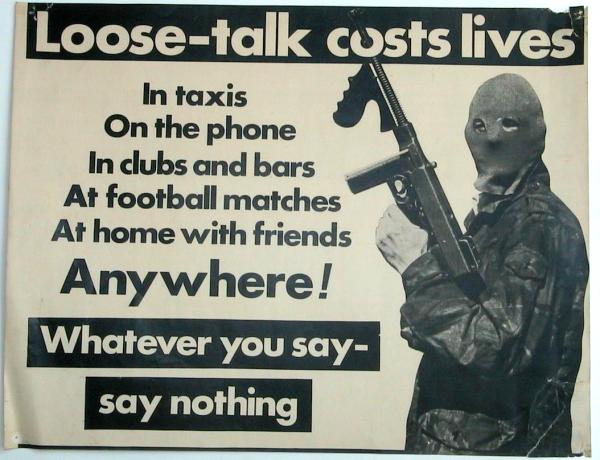
Originally, I unknowingly encountered the title of Seamus Heaney's
"Whatever You Say, Say Nothing" on a 1970's
political poster. This was long before I ever read the poem as assigned by a recent contemporary Irish literature course. The poster reads;
"Loose Talk Costs Lives: In taxis, On the phone, In clubs and bars, At football matches, At home with friends, ANYWHERE! Whatever you say, say nothing!"
The poster addresses the obvious issue of informing, knowingly or not, to members of the British security forces or worse even, to ruthless Loyalist murder squads. There is even a threatening undertone carried by the poster; perhaps wordlessly saying that you will be found if it is heard you informed. Informers are and have been the scourge of the Republican movement since the time of the United Irishmen. Measures to counter-act this terrible bain to the RM had to be taken.
The poem, on the other hand, is a literary jab at the culture of silence across the Six Counties. This culture of silence is in the process of being challenged head on by the proposed truth committees. After over 3 decades of bloodshed and sectarian conflicht, this culture of tight-lipped communities is just now beginning to lift.
The first line of this poem describes the generalized view that the world has of the struggle in the Six Counties. The sarcastically stabbing phrase, "views on the Irish thing," is an accurately declared truth of the worlds' perspective of this localised strife. The presses of foreign nations try to pin the fight on "religious differences." This may be accurate on the surface, but in truth it has always been an economic struggle; a class struggle. The Protestant majority at a time held all the well-paying jobs and those of the Catholic minority were either unemployed, or held relatively unskilled, low-paying jobs. To call it purely religious is to be ignorant of Irish history.
"Bad news is no longer news" is another compelling phrase. This struggle has gone on so relentlessly that bombings and shootings are no longer front page articles in the newspaper. The violence became part of everyday life for people living in the Six Counties. Even as a part of everyday life, the common people still avoid discussion of happenings for the most part. It is viewed as inappropriate chat between acquaintances and neighbours in most cases. Many people view the subject matter as more trouble than its worth to discuss.
What Heaney is trying to say is that the common citizen[sic] of the Occupied Six Counties tries not to show
strong political convictions, save at ballot time. This statement is shown true by the results of the last local elections in the Six Counties. Rising numbers of voters chose the more "radical" parties as the ones they wished to represent them at Stormont. This goes to show, the outward demeanor of the common people of the occupied counties does not show the truth of their political leanings.
"Maneouverings to find out name and school, subtle discrimination by addresses." This line is an additional one that must be discussed. This suggests (and is largely true, sadly enough) that average people in Six Counties discriminate on basis of what part of town you are from, what church you go to, what school you attend(ed) and what your first and/or last name is.
i.e: If your name is Daithi MacHugh , you are a
"sure-fire Pape" and will be treated accordingly by the community. If you have a British sounding name, you will be treated with more respect from members of the Protestant community, before they ever know your religion.
In the later stanzas of the poem, Heaney tries to give the reader a vivid image of internment camps and bomb craters. Machine-gun nests and reminders of Stalinist Russia. This poem makes pokes at long-standing ways of every day life in the Six Counties and has become a literary example used to explain some of the points of the violence to those not in the know.
I understand that some of the points I made above are very generalized and may not seem to cover all bases; but I am just attempting to put out a short review of my views on this increasingly popular poem.
Just a note to direct everyone to
1169&Counting. The authors of the site have done a nice piece on a rarely recognised Republican figure; Austin Stack. Another of that special breed of Republicans who did not posses a single shred of compromise in their bodies.
The article is in today's (Dec 12) published material, third piece down.
http://1169andcounting.blogspot.com/
Short useless bit on collusion:
It has been widely known that the
collusion between the British security forces and pro-Brit loyalist death squads was far reaching. Many deaths, some of complete innocents, were perpetrated as much by the occupation forces as by the loyalists.
The involvement with the RUC has long been known and was to be expected (not condoned! don't get me wrong). A good number of RUC officers come from hardline unionist and loyalist neighbourhoods. Therefore, their involvement with men that they probably went to school and church with as kid is not a surprise. But for the British to knowingly set up a group of soldiers and spies specifically to aid and work along side with sectarian MURDERERS is despicable and disgraceful.
The existence of the
Force Research Unit (FRU) as a branch of the British Intelligence in Ireland helps to prove the intent of the British to aid the scum loyalists in killing innocent Catholics. Many revelations have been made in the last 5 years or so about the extent of the security forces' involvement in loyalist arms and operations.
If it so happens
(and I'm willing to bet anything that it is) that most of the allegations brought against the FRU and the British are true; the scum need to face up and at least attempt to clear the water. You can run as many "independent" inquiries that you want; if the right people are not asked the right questions, then the true answers will never be known. It is the nature of the Troubles.
"Whatever you say, say nothing," to quote a very talented Irish poet.
A campaign for the truth of the deaths of dozens of people has been raging for nearly a decade. It has recently gained the fuel it needed to be widely known with no help from the pro-Brit/anti-truth media. With the
Stakeknife fiasco earlier in the year, the subject of collusion has begun to reach a fever pitch. Exposure of both Stakeknife and his handlers on a
New York based intelligence site has kept those out of intelligence circles relatively in the known on these controversial topics.
Links and Books related to the topic:
British Collusion in Ireland
Pat Finucane Center
British Collusion News List
A Very British Jihad
The Committee
Hidden Conflict Between the IRA and British Intelligence
Help the POWs and their families this Christmas
Christmas is right around the corner. With this in mind, I cannot stress enough that there are patriots stuck in Brit and Free State prisons this holiday. Please do whatever you can to help these men and their families get thru the holiday season. Anything you can do is appreciated and needed.
Irish Republican Socialist Prisoners information
Irish Human Rights Coalition
Political Status Petition
More Prisoner Information
Irish Freedom Committee POW Site
National Irish Freedom Committee POW Site
And for those of you in the Dublin area:
Take the plunge for the POWs!
Quotes relating to the last article, both historical and current:
We need to develop a Republicanism that doesn't accept institutionalisation and Armani suits.
Dr. Anthony McIntyre
Whoever betrayed the cause, or gave up the fight, or suffered loss of spirit, it was seldom the People. We are the People.
I.R.A. Handbook
I would walk from here to Drogheda and back to see the man who is blockhead enough to expect anything except injustice from an English Parliament.
Daniel O'Connell
We must see our present fight right through to the very end. Generations will continue to meet the same fate unless the perennial oppressor, Britain, is removed, for she will unashamedly and mercilessly continue to maintain her occupation and economic exploitation of Ireland to judgment day, if she is not halted and ejected.
Bobby Sands
The New Stormont is a step backwards-away from a free and independent Ireland.
Ruairí Ó Brádaigh
I am sorry to see ex-comrades sitting in Stormont. They had it in their power to strike a better deal. They've become British Ministers in a so-called Northern Ireland state. But in Irish history there has always been the native traitor.
Josephine Hayden
The fundamental principle of Republicanism is self-determination and not one shred of self-determination is involved in this 'peace accord.'
Bernadette Devlin McAliskey
Has any man here the hardihood to stand up and say that it was for this our fathers suffered, that it was for this our comrades have died in the field and in the barrack yard?
Austin Stack
If our last bullet had been fired, our last shilling spent & our last man were lying on the ground with his enemies howling round him with the bayonets raised ready to plunge into his body, that man should say – true to the tradition handed down – if they say to him “Now, will you come into our Empire” – he should and he would say “No, I will not.”
Cathal Brugha, 1921
Commentary on the Provisional sell-out
Since 1986, the leadership of Provisional Sinn Fein has continually reasserted the legitimacy of partition and in doing so, have shown their curtailment of Republican ideals that have been held true since 1916 and before. They have betrayed the memories of fallen United Irishmen, Fenians, Young Irelanders, and all of the other brave souls who gave their lives for the ideal of a completely free and United Ireland. Even family members of the 1981 hungerstrikers have made known their contempt for the sell-out that continues.
Men who once held legendary status within the movement have become no more than pawns and sycophants in game of political chess that has rehashed itself a slew of times in modern Irish history. From
Parnell and
Redmond to
Collins and
Griffith, the British political system has chewed up and spit out many of Ireland's patriots.
Provisional Sinn Fein has fallen away from Republican ideals and has adopted a sort of Constitutional Nationalism as a pathway for their politics. They have assumed their place on the avenue to uselessness and the outmoded. They’ve joined the "Republican Party"[sic] of
Fianna Fail and the
Irish Parliamentary Party as archaic and worthless political porticos.
The Provos in effect have reinforced the illegitimate puppet states formed by an illegal treaty of surrender. They are getting paychecks from the same governments that they had so vehemently opposed since the British government propped them up over 80 years ago. Hypocrisy at its zenith.
Handing over weapons that no longer rightfully belong to them, the Provos are committing an unforgivable act of treason and betraying the trust of the nationalist people of Ireland. The weapons that they are decommissioning to the Brits are the warranted property of the people of Ireland and to hand them over to the enemy is an act of surrender that is untenable. The enemy has
NOT left our country, and there is absolutely
NO conceivable way that a Republican should ever support a surrender of arms while the Brits still have a single foot on our island.
The facade that the Provos represent the fighters for Irish freedom needs to be surrendered along with their claim to legitimacy as a representative of the Republican community. Those who gave their lives for the ideals of Republicanism would be ashamed of the current process of concessions.
SMASH STORMONT!
STOP THE SELL-OUT!
Francis Hughes: Unwavering Republican
Born on the 28th of February, 1956, to a large Catholic family,
Francis Hughes grew up in the town of Tamlaghtduff, Bellaghy in South Derry along with his cousins and fellow Volunteers, Benedict and
Thomas McElwee. All three of these men were to serve long stints in the H-Blocks of Long Kesh; two of them were to never come out alive.
When Francis left school at the age of sixteen, he took up an apprenticeship as a decorator and painter. Upon completing this apprenticeship, he went on the run.
As a Volunteer he was brazen and fearless in the face of danger. His first stint of active service was with the
Stickies, but after their unilateral ceasefire, Francis became disillusioned and began running his own unit of men in independent operations. Rightly impressed, the Provos recruited the group as a whole in early 1973.
In the years to come, Francis' reputation as a courageous and bold Volunteer began to build amongst both the Nationalist community and the security forces in the Six Counties. The pressure to catch him came to a full head of steam in the spring of 1978, when he and another Volunteer had a gun battle with two SAS members, killing one and wounding another. The wounded soldier got off a burst of automatic sub-machine gun fire, wounding both Volunteers. Francis was hit in the thigh, preventing him from escape. He bade his comrade to flee and told him he'd fare for himself.
Francis was captured the next morning, having crawled nearly a half mile with a shattered leg. He was weak from exposure and blood loss, but was as defiant as ever. While they carried him away on a stretcher, he screamed "Up the PROVIES!" at the top of his lungs. At the time of his capture, Francis was being called "the most wanted man in the North[sic]"
Put on trial after a period of recovery from his injuries, Francis was put on trial and found guilty of murder as well as nearly a dozen other charges. He was sentenced to life for the killing of the SAS soldier; the other charges totalled 69 years in prison.
Arriving in Long Kesh, he immediately involved himself in the campaign for political status. On the blanket, he continued to build his reputation, defying the screws. They would do little to stop him; they were in as much awe of Francis as the POWs. He hobbled around on his crutches, yelling slogans and pick-me-ups to his comrades. Very few other prisoners in the history of the struggle could have gotten away with this without regular torture from the screws.
Francis was one of the 30 POWs who took part in the last stages of the
1980 Hungerstrike. This strike was called off when an apparent deal for political status was struck with the Brits. The British reneged on their original deal and the no-wash protest went on.
A second hungerstrike began on March 1st, 1981 when
Volunteer Bobby Sands refused his meals. Two weeks later, Hughes joined his comrade on the strike. On May 12th, after 59 days refusing food, Francis Hughes died, unbroken. He died for Ireland.
Francis Hughes: Ireland's Own
Francis Hughes: Scourge of the UDR: Ireland's Own
Hungerstrike Commemorative: Francis Hughes
Irish Hungerstrike Page
Noraid Hungerstrike Page
Attempt on the British War Cabinet, 1991
The IRA made an attempt to take out the entire British War Cabinet in February of 1991. With a salvo of improvised mortar bombs fired from a lorry, the Provisional IRA nearly took out the most important and high profile members of the British government in a single attack. This attacks' potential directly matches that of the Brighton bombing nearly 7 years earlier. It was daring and well-planned but fell upon bad luck.
Two of the three mortars fired came dangerously close to striking their target. One mortar hit a tree right in front of the building. Had this tree not been in the way, the mortar would have scored a direct hit on the government building. The second mortar struck the back garden of 10 Downing St. leaving a 2 metre crater and spraying shards of window glass onto the Cabinet members. The mortars apparently were miscalibrated by less than 10 degrees.
Training in mortar calibration and construction, and other related things needed to be elaborated upon. This took months to acheive acceptable levels of expertise for the active service unit. Therefore, the planning for the operation pre-dated both John Major's stint in office and the first Gulf War.
The Provisional IRA statement regarding the attack included the following: "Whether the Gulf War goes on for weeks or years, let the British government understand that, while nationalist people in the Six Counties are forced to live under British rule, the British cabinet will be forced to meet in bunkers."
The Provos had missed wiping out the entire British governmental elite by less then 15 metres. The headlines of the brilliant attempt dominated the news for the week. This attack helped to seal the thoughts in the minds of many British politicians that they would eventually have to deal with the Provos at the negotiating
table.
Support the push for FULL POLITICAL STATUS!
Support Republican prisoners and their demands:
(1) Separation of Republican prisoners from common criminals and loyalists.
(2) Recognition as a politically motivated group
(3) The right to have a spokesperson
(4) A wing of the prison as a space of their own
Do not let the veiled concession of partial separation fool you! FULL POLITICAL STATUS!
Irish Republican Socialist Prisoners information
Irish Republican Prisoners Welfare Association
Political Status Petition
More Prisoner Information
Irish Freedom Committee POW Site
National Irish Freedom Committee POW Site
Please do what you can to help the prisoners as the holidays approach. Any help you can provide will be greatly appreciated.
A little bit of history and culture for a change of pace
Most people understand that there is a common link between the people of Ireland and Scotland. Everyday similarities and common links are made with links in last names and sport. In truth, the link is shared more closely by blood than most realize. We may share our names beginning in "Mac" and "Mc" and our Glasgow Celtic, but we are brothers and sisters in terms of nations as well.
When the Roman forces withdrew from southern Scotland in the late 4th century AD, they left behind the unconquered tribes of the Picts and the Caledonii. These fiercely independent peoples eventually combined to form the Pict nation mainly residing in the lower Scottish Highlands. Elsewhere in Scotland around this time, tribes of the East Antrim kingdom of Dalriada were arriving in what is now Argyll.
The truth of the matter is that the first name in the oldest record of Scottish royal pedigree, the
Book of Ballymote, is Angus Turbech of Tara; a name which denotes direct lineage from the High Kings of Ireland. Angus was High King from 384 to 325 B.C., according to the
Annals of the Four Masters. The Scottish royalty is therefore directly related to the derivation of the extinct blood-line of Irish royalty.
The Latin words Scoti and Scotia were originally used by the Roman's to refer to the Irish Gaels and Ireland respectively but eventually came to represent the Irish from the Dalriada kingdom in Argyll. After the 9th century, these ancient Gaels were further known as the Scottish and the land they inhabited as Scotland, literally the "land of the Irish."
This migration explains the strong similarities between Ulster Irish Gaelic and Scottish Gaelic. It also explains the strong ties that the Scots and Irish still share; especially culturally.
There is one link between these two sister countries that makes my stomach turn though. That is the terrible plight of sectarianism. Glasgow to Antrim, this link terrorises youths and the elderly alike. What is the point of this violence? I hope that someday in a near future, bigoted eejits will open their eyes and see that they really are not much different than those they hate.
Jeremiah O'Donovan Rossa: Unrepentant Fenian
Jeremiah O'Donovan Rossa is best remembered by most modern Republicans for his funeral. It is at this funeral that Padraic Pearse gave one of the most memorable and rousing speeches in the oratory history of the Irish. The truth is that Rossa did much for the Republican movement and this needs to be heard.
Rossa was born Jerry Donovan in Clonakilty, Co. Cork in 1831. He lived through the Great Famine and witnessed its massive devastation and his people's suffering. He tried to help alleviate this suffering by working for some time as a relief worker.
In 1856, Jeremiah became a shopkeeper in Skibbereen where, in 1856, he founded the Phoenix National and Literary Society 'for the liberation of Ireland by force of arms'. His society held public demonstrations at which speeches were given and literature handed out. It was at one of these rallies that Rossa was arrested by the British and interred without trial for eight months.
In 1863, Rossa began contributing letters to James Stephens' paper,
The Irish People. After a few months, Stephens invited him to join the papers staff as the business manager.
Jeremiah O'Donovan Rossa was accused of plotting a Fenian rising in the spring of 1865 and put on trial for high treason. He was found guilty and sentenced to penal servitude for life. He took advantage of his right to deliver a lengthy speech in defence of himself. This speech from the docks lasted a full eight hours and assailed everything from British tyranny and injustice to the incompetence of his sentencing judge, William Keogh. In 1869, he was elected as a member of Parliament for the Tipperary district in a by-election. The British stripped the election win from him, claiming that his crimes voided his success.
Released in 1871, Rossa sailed for New York City, where he was greeted with the open arms of fellow ex-patriate patriots. He became an editor of the New York edition of the
United Irishmen and a figure within Clann na Gael. After some disagreements with the "moderatism" of John Devoy, Rossa split with CnG in 1880 and organised a fund to support the arming of those still willing to fight the British with force. This so called "Skirmishing Fund" caused a Ms. Yseult Dudley, a furious Englishwoman, to shoot Rossa in front of his office in the winter of 1887.
Jeremiah O'Donovan Rossa released a number of books during his lifetime. They include:
Rossa's Recollections,
Irish Rebels in English Prisons,
My Years in English Jails,
A Record of Prison Life, and
A Story of Ireland In Our Day.
Rossa died on the 29th of June, 1915 and his body was sent back to Ireland and received with a hero's welcome. His funeral was held at Glasnevin Cemetery on the 1st of August. This funeral featured a number of high profile speakers of the revived Irish Republican Brotherhood, but the
graveside oration of Padraic Pearse is the most remembered and repeated.
It was Rossa's funeral and the speeches it prompted that inspired a whole generation of Republicans.
Since I have used the
Irish Republican Bulletin Board so often to learn and ask questions over the last year or so, I feel the need to credit them for at least a small portion of my knowledge. This board is very active and spurs intelligent and extensive debate. All points of view are encouraged to join and participate as long as the rules of the board are upheld.
The board is moderated and maintained by
Na Fianna Eireann, the true Republican Youth Movement. Na Fianna Eireann "reject all treaties and boundaries which make Ireland less than a nation free from the centre to the sea. Na Fianna Eireann pledges its allegiance to the Sovereign Independent Irish Republic proclaimed in 1916 and ratified in the National Parliament of the Irish People on 21st January, 1919. The organisation recognises not Treaties or Boundaries which make of Ireland anything less than a Sovereign, Independent State from the centre to the sea. The organisation is non sectarian."
In matters of principle there can be no compromise.
Frequently, in discussion with Republicans of all persuasions, I am confronted with the question of "which is the true and rightful IRA?"
Here is one perspective on the issue from a non-aligned republican activist and author
Liam O Comain. O Comain comes to the conclusion that the Provos have forfeited their right to claim status as the Army of the Irish Republic. He also dismisses the Real IRA as a fracture of those same Provos.
Liam O Comain's left with one choice, the Continuity IRA. I agree with Mr O Comain on this subject. The Continuity IRA remain as the only group espousing the true ideals of the Oglaigh na hEireann.
Now comes the related and ever compelling debate of "
Provisional versus
Republican Sinn Fein?" This debate is repeated often on a Republican Forum that I frequent. This Forum is the
IRBB and is maintain by
Na Fianna Eireann.
Here is the general idea of the position I support and the reasons for this stance:
First of all, the Dail Eireann, the rightful government of the Irish Republic, directly delegated its authority to the Army Council of the Irish Republican Army. The remaining deputies of the Second Dail appointed the Army Council of the IRA the rightful governmental force in 1938. Later, after the Provisionals split in 1969/1970 this same power was place upon the Provisional Army Council by the remaining deputies of the Dail Eireann. In 1986, the same power was placed on the Continuity Army Council by the single remaining member of the second Dail's Executive, Tom Maguire. Thus completes the
direct lineage of authority.
Secondly, the vote carried out at the 1986 Sinn Fein Ard Fheis was in direct contradiction of an Army Council vote that happened previously. The Army Council decided in a vote of 6 members to 4 against recognising the Leinster House as a legitimate government.
Ruairi O Bradaigh and Daithi O Conaill were absolutely correct in their prediction that the recognition of the Leinster house would eventually lead to the revival of Stormont and Sinn Fein members sitting in that illegal institution.
In the end, I believe that O Bradaigh & Co. were correct to oppose the sell out of republican ideals. And they are still correct to continue doing so. Republican Sinn Fein is the only party in Ireland left that expresses ideals that remain true to the ideal of 1916.
"The justification for entering Leinster House has been, that the majority of the South see it as their legitimate parliament. If one accepts such a principle, then it is logical to advocate entry to a New Stormont and Westminster because the majority of the people in the Six Counties accept them as legitimate parliaments. Principled leadership cannot have it both ways; one cannot divide a principle." -Daithi O'Conaill, 1986
Jean McConville -
Collected information and my thoughts, however uneducated and misinformed
My sources, limited as they may be, cover a number of bases. The books and people I used in my research on the topic are as follows:
Secret History of the IRA by Ed Moloney
Lost Lives by David McKittrick
Armed Struggle by Richard English
Disappeared - The Search for Jean McConville by Seamus McKendry
Liam Clarke of
The Times
I would also like to thank Dawn of
Ireland's Own for her research recommendations regarding this topic.
Here are the "facts" as I've collected them:
According to mass media sources, Jean McConville was killed because she aided a British soldier who was wounded during a gun battle around Divis Flats. When one searches deeper into this subject, you realize that this claim is complete rubbish. Whereas, this act may have angered the deeply nationalist Divis area, it would have not warranted her execution at the hands of the IRA.
Jean was a natural outsider in Divis. She was a Protestant from East Belfast who married a former British soldier. Her husband had died some time before and she was left alone with her 10 children. The fact that she was an "informer" seems to me to be complete trash also; what level of intelligence could she be passing on? There was nothing that she could know that an undercover British soldier couldn't figure out from spending a decent amount of time in Divis Flats.
According to Ed Moloney, the IRA in the area became wary of Mrs. McConville's questioning and probing and decided to search her home. They "found" a transmitter for contacting her handler. She was given a warning to cease all contact with British intelligence and allowed to go on her way. She again, PUTTING HER CHILDREN AT RISK, began spying again. I cannot believe this account purely for this reason. Why would a widowed mother of
10 put her entire family at risk for this?
Moloney also claims that McConville was given a court-martial without her present by the IRA leadership in Lower Falls the night before the incident. This would implicated Mr. Gerry Adams in this situation, as he was the apparent head of the Belfast Brigade at the time. Adams would have been well aware of this whole situation happening.
Lost Lives claims that Mrs. McConville was dragged from the bathtub in her home by 4 masked women on the night of December 7th, 1972. Helen McKendry, Jean's eldest daughter, claims that later in the week, people showed up at the McConville home and handed Helen Jean's rings and purse and walked away. The daughter also says that she was later told by an anonymous person that Jean had been killed with a plastic bag around her head. This claim turned out to be
false.
- - - - - - - - - - - - - - - - - - - - - - - - - - - - - - - - - - - - - - - - - - -
My take on the issue is that Jean McConville may have been some kind of informer, but the level and quality of information that she would have been able to pass on would have been laughable. It would have been nothing British intelligence didn't already know or could have easily found out on their own. Perhaps British intelligence is just as much to blame for the situation as anyone else. They were the ones who chose to allow a
MOTHER OF 10 to do their dirty work.
Also, it is deplorable the amount of time that it has taken for IRA leadership to relinquish to location of Mrs. McConville's body. Rightfully, this act should have been a part of the "peace process" ten years ago. And let's not forget that there are still five admitted of the so-called "Disappeared" that have yet to be located. Four bodies have been located and rightfully buried.
More information on the Disappeared of the Provisional IRA can be found here:
Ireland's Own
Now that the elections have come and gone...
Here is what the Unionist electorate voted for.
Quotes from the DUP leader Rev. Dr. Ian Kyle Paisley
The Catholics have been interfering in Ulster's affairs since 1641
The Roman Catholic Church is getting nearer to Communism every day.
God has been our help in 1641, 1688, 1690, 1798, 1912, and 1920 and he will not fail us in the future.
I have reason to believe that the fowl-pest outbreaks are the work of the IRA.
(Yes, Ian... there there now, the IRA were killing off the fecking chickens...)
Line dancing is as sinful as any other type of dancing, with its sexual gestures and touching. It is an incitement to lust.
You cannot talk peace until the enemy surrenders and the enemy is the Roman Catholic Church.
The chickens are coming home to roost.
(about the UUP)
We do not accept the word of the slanderous bachelor who lives on the banks of the Tiber.
Mr. Faulkner has sat down with the greatest IRA man of them all -
Jack Lynch.
The Minister of Education?
A few months ago I read Liam Clarke and Kathyrn Johnson's unauthorized biography of Martin McGuinness,
From Guns to Government. After reviewing it again, I now want to take the time to comment on this book a little bit further.
I have heard some mumblings that a lot of the information collected in this volume is either hearsay or misconstrued. At face value, I took a lot of the writing with a grain of salt. I understand why McGuinness did not cooperate with
The Times. The paper Clarke represents has repeatedly misrepresented and misinterpreted the Republican position since the beginning of the Troubles. This is a right wing paper who's view of the IRA has always been that they are out and out terrorists.
An acquaintance of McGuinness' in Derry, Denis Bradley, is someone I regard as trustworthy and very sincere. He has written a couple of good articles for the Irish News on the transition from the bullet to the ballot box. Bradley did a review of the book in question and effectively tore it to pieces.
Bradley questioned many of the people cited as sources or probable sources throughout the book and a vast majority of them denied having ever been interviewed. The point is that Clarke may have either found this information from other uncited sources or just plain made it up.
Most of the sources who were verified have a probable axe to grind with the former Education minister.
It is suggested that McGuinness' role in the peace process was just a cop-out on his part to keep himself out of jail. One of the Army Council's well-known hawks, McGuinness, according to Clarke, was forced to act as chief negotiator for Sinn Fein in dealings with the British government.
Clarke simultaneously portrays McGuinness as a cowardly, self-absorbed, ruthless and callous man while still showing him to be dedicated, unwavering, intellectual and a strategical genius. The author even dares to hint that McGuinness had "guardian angels" within the ranks of Mi5 and Mi6.
Many of Clarke's suggestions about McGuinness' good luck at avoiding capture are left open-ended. The reader must decide what is being hinted at in these claims.
Here we have a man who openly told a Dublin courtroom that he was "a member of Oglaigh na hEireann and very, very proud of it." He has often been described as the "ideal" Provo. The so called "Godfather of godfathers" of the Provisional mov't. And here is a man in Clarke who is claiming that all along he has been protected and supported by British intelligence.
This book has no substance except for amusement purposes only.